_
_


Welcome one and all to the 'Philippine Railway Historical Society' blogsite. This site was set up to share photos, historical pieces, comment and virtually anything else pertaining to transportation in the Philippines, with a special emphasis on rail. Occasional we vary from topic, but this is the less serious side of the hobby shining through - cause sometimes, in this miserable and uptight world, we just take ourselves a little too seriously.
Since 1999, the Philippine Railway Historical Society has regularly published items, FOR FREE, of railway interest on our PRHS Website. These include locomotive, rollingstock and transit updates, as well as our occasional magazine, 'Along Da Riles'.
Our interest base has grown over the years with our main Facebook railway group expanding to include groups interested in other Philippine Transport, modelling of Philippine transport and even a group for Philippine railfans interested in overseas railways.
If it sounds interesting, come join in the fun of the oldest, and most diverse, group dedicated to Philippine railways and other transport.
We look forward to meeting you.

If you have a question Philippine railway related, just drop us a line, maybe we can help.
_
_


Tuesday, June 24, 2025

NAGA STATION 2010 - PART 2


It's getting near on a decade and a half ago that my friend David and I travelled on down to Naga for a few days.
Down there we were to catch up with fellow Aussie mate Paul, inspect the line to Legaspi, ride the Bicol Commuter, and have a good explore of Naga station and yard.

Such is the size of Naga, this posting is over two parts. Even more if you include all the other station visits to come.

The future of this important yard is in doubt with the proposed 'South Long Haul Project' including plans to put Naga station outside of the main city to ease congestion and ease curvature.

Interested In All Things Philippines? We Have Heaps.

Naga Railway Station, located in Naga City in the Bicol region of the Philippines, has a significant history tied to the development of transportation in the country.

The station was established as part of the Philippine National Railways (PNR) system, which was originally operated by the Manila Railway Company (MRC) in the early 1920. Naga served as a crucial hub for travelers and goods moving between the Bicol Peninsula and Manila.

Over the years, the Naga Railway Station became vital to the local economy, connecting the region with major cities and providing an important mode of transportation. However, like many other railway systems in the Philippines, the Naga station experienced a decline in service during the late 20th century, particularly with the rise of road transportation.
Today is operates services north to Sipocot, and south down to Legaspi.
---------------------------------------------------------

Are you interested in the fascinating sugarcane railways  on the islands of Negros and Panay (Philippines)?
We have started a new specialising in this topic, aimed at local historians, railfans interested in these railways, and people with a general interest in the industry. 
---------------------------------------------------------


CAR-2 sitting around Naga yard (Bicol region).
Photo: Brad Peadon


BC-649 repainted blue, with orange band and Philtrak logo of the era.
Photo: Brad Peadon


Above and below.
A look both ways along Naga platform from inside the entrance back in the days before the over 
authoritative security guards infested the entrance.
Photos: Brad Peadon


Bicol Commuter timetable back in 2010, with services north to Sipocot (as is the case today), and 
south as far as Ligao (today they have returned to Legaspi).
Photo: Brad Peadon


Above and below
U15C 922 looking absolutely resplendent in her new Filtrak livery sits inside the Naga shed.
Photos: Brad Peadon


BC-677 was another boxcar painted blue by the Naga crew. However it neither got the 
orange band, or the modern Filtrack logo.
Photo: Brad Peadon


GC-1 in yard with a load of dirt and a random tyre.
Photo: Brad Peadon


The end of Naga yard, looking southwards towards Legaspi.
Photo: Brad Peadon


Looking northwards across Naga yard.
Photo: Brad Peadon


FL-53 with a load of rail.
Photo: Brad Peadon


BC-597 has also had the blue treatment.
It is believed most of these blue vans were later towed to Legaspi. However, from all reports they have 
mysteriously disappeared from there and not been seen since.
Photo: Brad Peadon


A more elevated shot of CAR-2.
Photo: Brad Peadon


Above and below
U15C 918 arrives with the Bicol Commuter.
Photos: Brad Peadon


Above and two below.
U15C 918 at Naga station preparing to depart for the run to Ligao.
Photos: Brad Peadon


The Naga station dunnies are quite a nice looking structure.
Photo: Brad Peadon


Cab of 918.
Photo: Brad Peadon


South end footbridge at Naga station. This bridge was closed by the time of my 2022 visit, and the 
north one looking to be none to well either.
Photo: Brad Peadon


Above and two below.
North entrance into Naga yard. The tracks to the right lead to the yard, loco shed, and triangle (wye if you so prefer).
Photos: Brad Peadon


 Locals walking along the tracks south of Naga as await the Bicol Commuter.
Photo: Brad Peadon


Above and below. 
918 scurries along with the Bicol Commuter train just south of Naga.
Photos: Brad Peadon


Above and below.
It must take incredible skill to not fall off the railhead with the pushbike and sidecar.
South of Naga.
Photos: Brad Peadon


---------------------------------------------------------


---------------------------------------------------------

MrX, Nhing, and Onyo.

PNR Management & Staff.
wikipedia.org


Interested In All Things Philippines? We Have Heaps.

---------------------------------------------------------

A guide to Philippine transport websites and groups.
A list of recommended genuine locations to find further information on Philippine transport topics 
that will be expanded on from time to time.


Tuesday, June 10, 2025

HAWAIIAN-PHILIPPINES COMPANY - 2025 VISIT - PART 3 - TO LOCOSHED


--------------------------------------------------------------

Hawaiian-Philippine Company 2025 

 Part 3

In March of this year, we were incredibly fortunate to be warmly hosted for a visit to the historic Hawaiian-Philippine Company sugar mill in Silay City, about 28 minutes north of Bacolod in Negros Occidental, Philippines.

Unlike our somewhat impromptu visit in 2023, this time I opted for a more official approach. With the kind support and blessing of the company chairman, we were granted the opportunity to experience what turned out to be one of the most unforgettable moments in my 26 years of exploring the railways of the Philippines.

In part 3 we check in to the Hawaiian-Philippine main office, and are taken through to the loco shed.

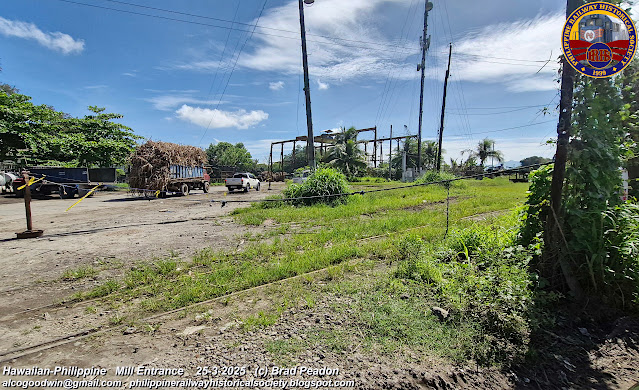
On my first visit I never really took any images of the still existing track layout within the mill processing area, so wished to rectify that oversight on this visit.
Below are some of the shots of the track on the way through.
As I have a general interest in the sugar milling industry as a whole, and have been into a couple of Aussie ones, it was fascinating to finally have the opportunity for a better look at this wonderful mill.

-------------------------------------------------

Some people I really must thank.


Mill Chairman: Mr Paul Andrew Curran

Thank you sir so much for allowing my visit to your mill, and for ensuring a link to the amazing heritage of the sugar industry of the Philippines.

HR Division Manager: Ms Gloria Pasustento

For your wonderful help organising our visit.  

CoGen Head & Steam Loco Operation: Mr Rodeo Suating

Also to all the train operating division and the other mill staff. All who were so incredible.

-------------------------------------------------

Are you interested in the sugarcane tramways and industry on the islands of Negros and Panay (Philippines)?
Also covering the timber/sugar railways of Leyte, Cebu and Mindanao.

-------------------------------------------------
The Hawaiian-Philippine Company (HPCO), established in 1918, is the oldest operational sugar central in Silay City, Negros Occidental, as well as one of the oldest in the country. Founded by members of the Hawaiian Sugar Planters' Association, HPCO aimed to reduce production costs and provide employment to locals. Grinding operations commenced on January 15, 1921. ​

  Over the decades, HPCO has maintained its prominence in the sugar industry. It is one of the few producers of muscovado sugar, producing it through traditional artisanal methods. Additionally, HPCO operates a couple of steam locomotives for special occasions, occasionally even on sugarcane haulage duties, reflecting its rich industrial heritage. ​

  Today, HPCO stands as a testament to the enduring legacy of sugar production in the region, blending historical traditions with modern practices.


Above and below.
Former western rail entrance to the Hawaiian-Philippine Company sugarmill.
Photos: Brad Peadon


Start of the now closed Harbour line to the west of the mill.
 The most recent image I have seen of this line in use was 2017. I would appreciate learning of when it was last used.
Photo: Brad Peadon


Rope shunting at the western end of the Hawaiian-Philippine yard.
Photo: Brad Peadon


A wee bit further down the former Harbour line.
Photo: Brad Peadon


Above and two below
Entrance to the main Hawaiian-Philippine office.
Photos: Brad Peadon


Joining me on my visit were Dave (left) and Kevin (right).
Photo: Ana Peadon


Hawaiian-Philippine office.
Photo: Brad Peadon


Above and two below.
Walking over the the mill itself.
Unsure what they was the loading on the truck below. I would assume bagged sugar.
Photos: Brad Peadon


Team PRHS gearing up for entry.
Photo: Brad Peadon


Above and four below
My main aim was to cover the railway related stuff at the mill. Kevin and Dave pass over the first few sidings passed. They did not appear used.
Photo: Brad Peadon


Above and six below
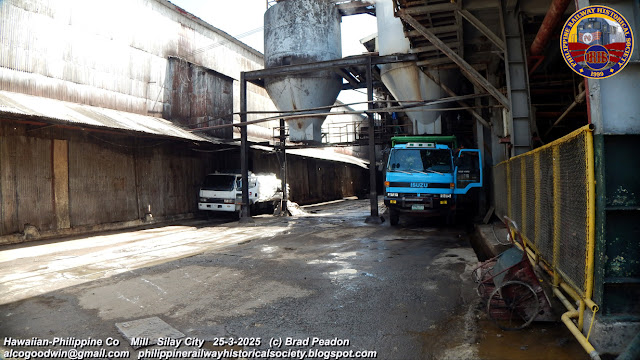
Numerous mill photos of a non-railway nature.
Photos: Brad Peadon


A loop of track just visible at the bottom of the photo.
Photo: Brad Peadon


 Further along the loop mentioned above.
Photo: Brad Peadon


 Loop looking in the other direction, with a number of cane trucks. Truck 0915-6 being closest to the camera.
Photo: Brad Peadon


Above and two below 
More mill photos.
Photos: Brad Peadon


Above and four below. 
Pointwork at the north end of the loop.
Photo: Brad Peadon


Exiting shed at north end of the loop and looking back towards the rail yard.
Photo: Brad Peadon


 Upon reaching the locoshed area we were surprised to find #2 'Isabella Curran' (originally #5) in steam with Plymouth #17 approaching in the background.
We were to find out that it was in steam to shunt the last remaining field line especially for our visit.
Photo: Brad Peadon
--------------------------------------------------------


---------------------------------------------------------
Nhing Tin & Driver Chris Tablero
Kevin Long & Dave
Management, train, mill, and security staff.


Railways Of The Philippines - Reg Carter
Wikipedia


Interested In All Things Philippines? We Have Heaps.


Are you interested in the sugarcane tramways and industry on the 
islands of Negros and Panay (Philippines)?
Also covering the lumber/sugar railways of Leyte and Mindanao.